©

ADDRESS
via di Campo marzio, 4
34123 Trieste, ITALY
tel. +39 040 2450325
info@erikaskabar.com
ABOUT
BACKGROUND AND PRACTICE
We are a landscape architecture practice
working at the intersection of ecology, infrastructure, and health.
We support public authorities, institutions, and interdisciplinary teams on projects where landscape is a core structural issue — not a finishing embellishment.
WHO WE ARE
The practice is led by Erika Skabar, landscape architect highly experienced in:
- complex infrastructure-landscape integration
- governance of long-term transformation processes
- multi-disciplinary coordination and strategic advisory.
Erika’s work spans design, research, and teaching, informing a practice grounded in clarity, responsibility and long-term vision, not stylistic application.
WHY THIS MATTERS
Because landscape decisions matter —
early, spatial, environmental, interdisciplinary.
When these choices shape performance, we provide frameworks that hold complexity together.
ABOUT ERIKA SKABAR
How does a landscape practice take shape over time?
Erika Skabar graduated in Architecture from IUAV University of Venice in 1994 under the guidance of Ippolito Pizzetti.
This formative experience shaped her understanding of landscape as an interdisciplinary field, where design is based on interpretation and listening rather than control.
Her intellectual background is informed by the philosophy of gardens and landscapes, drawing on Rosario Assunto, Rudolf Borchardt, and Georg Simmel, alongside aesthetics and the philosophy of nature.
Her early professional work developed across Italy, Austria, the Balkans, Brazil and Portugal, exploring the relationship between art and landscape through installations, land art, and international competitions.
Notable projects include the international design for Piazza Unità (1997), coordinated by Gino Valle as part of the Soundscaping project, and the landscape design for the Museum of Contemporary Art at Casa Serralves, Porto, developed under the direction of Álvaro Siza Vieira—where artworks by Richard Serra, Claes Oldenburg, and Dan Graham are integrated as part of the landscape structure, rather than introduced as autonomous elements.
Over time, her practice has focused on large-scale and complex public projects and complex public projects.
She collaborates with international firms including Renzo Piano Building Workshop, Richard Rogers Partnership, and Richard Meier & Partners, developing extensive experience in shared design processes and multidisciplinary coordination.
Her work spans architecture, urban planning, geotechnics, mobility, infrastructure, coastal engineering, and sustainable energy systems, addressed as interrelated components within a single project framework. This approach allows constraints to be identified early and translated into integrated and durable design solutions, supporting continuity from concept through implementation.
Alongside professional practice, she has an established role in academic teaching and research, having taught at the Department of Architecture, University of Ferrara as Professor of Professional Practices and Coordinator of the Landscape Infrastructure Design Lab, and delivered lectures at IUAV University of Venice and the Institute for Art and Architecture, Academy of Fine Arts Vienna.
For Erika Skabar, theory and fieldwork are inseparable.
Planning tools are developed in direct relation to materials, soils, and ecological rhythms, integrating green infrastructure, ecosystem services, sustainable land management, and soil regeneration strategies, particularly in response to climate change.
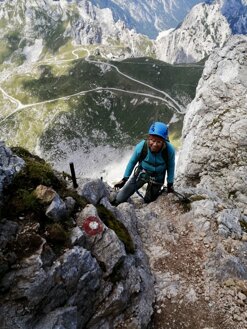
Practice is also a matter of soil
Erika Skabar has worked in plant nurseries, joined plant-hunting expeditions to study species in their natural habitats, and spent long days in constructing her own garden.
Through these hands-on experiences, she continually refines her approach, deepens her expertise and, above all, reconnect with the earth by getting her hands in the soil.
SELECTED RECOGNITIONS
- Fondazione Barbara Cappochin Prize 2022 – Special Mention, International Prize
Infrastructural landscape project along the Transalpine Pipeline - RIBA Awards 2014 – European National Winner
Scandicci Town Centre
- AR Emerging Architecture Award 2007 – Honourable Mention
Pitagora Park and Museum, Crotone - Promo U.R.B.A.N. Award 2006 – Award for Environmental Quality
Eastgate Park, Pirelli Re
Selected Recognitions
We believe landscape is not defined by style, but by attention, structure and care over time.
This belief informs how we observe, design and collaborate — across projects, disciplines and territories.