©


ADDRESS
via di Campo marzio, 4
34123 Trieste, ITALY
tel. +39 040 2450325
info@erikaskabar.com
KEY PROJECT
HEALTH AND LANDSCAPE
CAN WE START TALKING ABOUT THE RIGHT TO LANDSCAPE AS INTRINSICALLY LINKED TO HEALTH AND WELLBEING ACROSS GENERATIONS?
SESTO SAN GIOVANNI HEALTH AND RESEARCH CENTER
SHAPING HEALTH TROUGHT LANDSCAPES
Location: Sesto San Giovanni, Milano - Italy
Client: Regione Lombardia, Infrastrutture lombarde, Fondazione I.R.C.C.S Istituto neurologico Carlo Besta, Istituto nazionale dei tumori, Aria Spa
Lead Architect: MCA Srl, Bologna
Period: 2025 - 2013
Scope: Landscape General project, from Competition phase to Construction documentation
Project status: On site
Credits: Cisar SpA- DBO; MCA Srl - Architecture; SD Partners Srl, Tech Project Srl - Structural Engineering and Viability Studies; Ariatta Srl - MEP, Prodim Srl - HVAC; Gae Engineering - Fire Engineering; Studio Raffaelini - Acoustics Engineering; Arch.M.Moglia - Healthcare Facilities; prof. M.Plebeni - Laboratory consultancy; Prof.A.Crespi - Radiation protection
Context
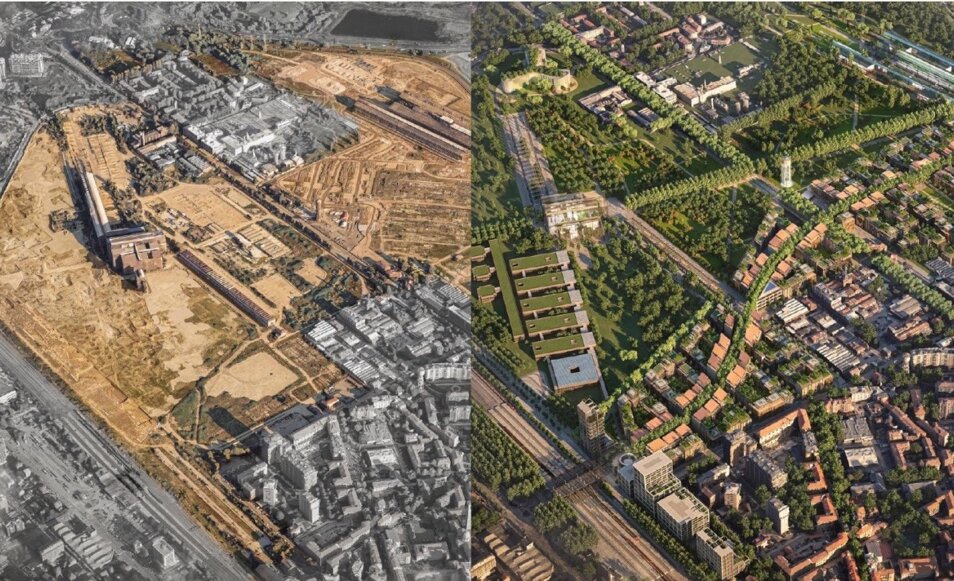
The Health and Research Centre in Sesto San Giovanni is a large-scale healthcare-led urban regeneration project developed on the former Acciaierie Falck industrial site, within the masterplan framework designed by Renzo Piano.
The intervention integrates hospital infrastructure, research facilities, and landscape systems within a single coordinated framework, where healthcare acts as a driver of territorial transformation rather than an isolated functional enclave.
Based on the awarded master concept, the healthcare complex covers approximately 135,000 sqm and includes 650 hospital beds, 50 health hotel beds, 16 operating theatres, and a dedicated oncology and neuroscience research hub. The Centre is designed to accommodate around 3,000 staff and to deliver over 1.5 million outpatient services and approximately 24,000 inpatient admissions per year.
The surrounding public park (approx. 234,000 sqm) functions as a strategic landscape infrastructure, connecting the healthcare campus with the urban fabric of Sesto San Giovanni and the wider Falck district.
In this context, access to landscape is not an amenity but a for patients, staff and visitors on the one hand, and for local residents and public park users on the other.
Challenge
The project required a landscape system capable of operating within a highly regulated healthcare environment, where spatial clarity, environmental performance, accessibility and long-term management are critical.
Key challenges included:
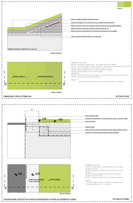
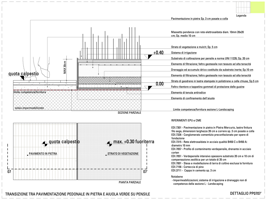
- integrating landscape with complex architectural layouts and underground technological systems
- strengthening ecological infrastructure, particularly for urban heat island mitigation
- ensuring continuous and equitable access to outdoor space for patients, staff, and visitors
- responding to changes introduced by the updated masterplan (PII) variant, which replaces the former buffer zone with direct adjacency between the healthcare park and a new residential and service edge
This condition required landscape to operate as a mediation system between fundamentally different uses, balancing protection of the healthcare environment with public accessibility.
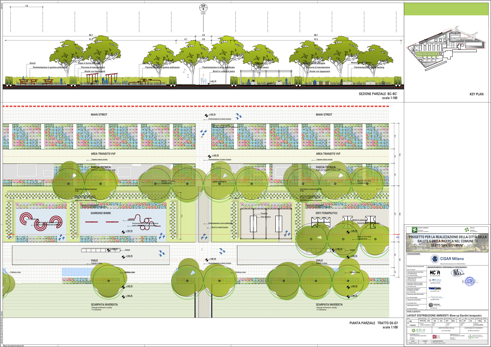
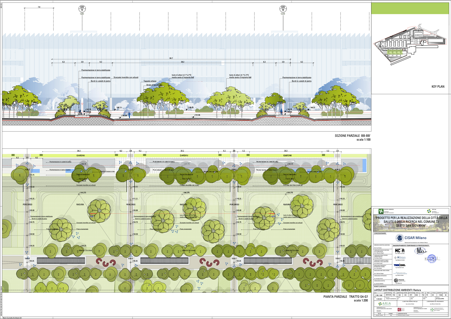
Landscape strategy
Landscape was developed as a rational, performance-driven system, aligned with architectural geometry and infrastructural constraints.
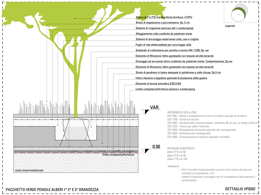
The park structure follows the organisational logic of the healthcare buildings and integrates the constraints imposed by underground infrastructures into the design of open spaces and vegetation systems.
A spatial gradient defines the landscape:
- structured and controlled spaces in proximity to the buildings
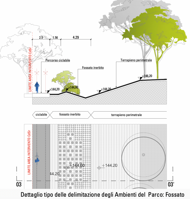
- progressively more naturalistic environments toward the outer areas.
Vegetation systems are designed to deliver measurable environmental functions, including:
- microclimate regulation and urban heat island mitigation
- air quality improvement
- ecological continuity and biodiversity support.
The buffer and mediation strip along the western edge combines environmental mitigation with public accessibility, ensuring protection of sensitive healthcare functions while maintaining the public character of the open space.
Role and responsibility
Landscape General Project, including:
- development and coordination of the landscape framework across all design phases
- integration of landscape with architectural, infrastructural, and environmental systems
- definition of vegetation structures, open-space organisation, and environmental performance measures
- design of the buffer and mediation strip following the updated masterplan (PII) variant.
The role focused on ensuring coherence, constructability, and long-term operational performance of the landscape system.
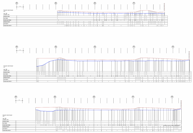

LANDSCAPE ACCESS AS HEALTH-RELATED RIGHT.
Value for the project
The project demonstrates how landscape can operate as a core infrastructural component within a healthcare environment.
By embedding landscape into the spatial and operational structure of the campus, the project establishes the right to landscape as an operational condition: equitable access to outdoor space that supports comfort, orientation, environmental quality and everyday use for patients, staff, and visitors.
Landscape contributes to:
- improved environmental performance through ecological infrastructure and heat mitigation
- clearer spatial legibility within a large and complex healthcare campus
- improved working conditions for healthcare professionals
- effective mediation between healthcare facilities and the surrounding urban fabric.
In this context, landscape is not an amenity, but a risk-reducing infrastructure supporting healthcare delivery, long-term management, and public value.

Build Healthy Cities
By 2050 two-thirds of humanity will live in urban areas.
The actions we take over this next decade will define the planet's path.