©


ADDRESS
via di Campo marzio, 4
34123 Trieste, ITALY
tel. +39 040 2450325
info@erikaskabar.com
KEY PROJECT
INFRASTRUCTURE AND LANDSCAPE
HOW CAN STRATEGIC INFRASTRUCTURE BECOME PART OF THE LANDSCAPE RATHER THAN FRAGMENT IT?
TRANSFERLINE PROJECT FOR TRANSALPINE PIPELINE
ORGANISING INFRASTRUCTURE AS PART OF A CONTINUOUS TERRITORIAL SYSTEM
WHAT DO WE MEAN WHEN WE SPEAK OF AN INFRASTRUCTURAL LANDSCAPE PROJECT?
An infrastructural landscape project addresses the systems that allow territories to function, remain accessible, and perform over time.
Infrastructure underpins urban and regional operations, supports economic activity, and frames development conditions, typically guided by policy objectives such as efficiency, safety, and environmental responsibility.
Despite this role, infrastructure is often treated as a stand-alone technical object, with landscape addressed only once engineering requirements are resolved.
An infrastructural landscape approach challenges this separation by recognising infrastructure as an integrated spatial, environmental, and cultural system.
This requires an interdisciplinary framework in which infrastructure, land management, biodiversity, and landscape values are considered as interconnected processes.
Landscape operates as an organising medium, supporting coherent decision-making across complex technical and territorial contexts.
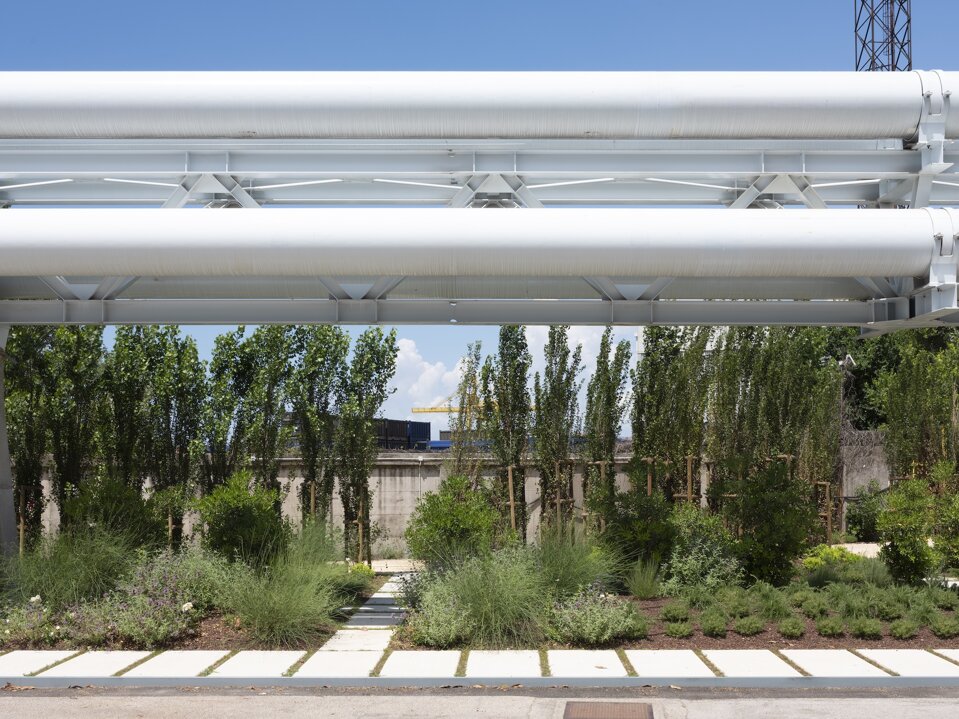
INFRASTRUCTURE: NOT A RESIDUAL TECHNICAL SPACE, BUT A ACTIVE TERRITORIAL SYSTEM.
Location: Trieste, - Italy
Client: TAL OIL Group - SIOT - Società Italiana per l’Oleodotto Transalpino S.p.A
Period: 2021-2013
Scope: Head leader; Coordination and Landscape General project, across Schematic Design, Developed Design and Construction Documentation
Consulents: F&M Ingegneria - Venice (Geotechnics and Structures); ILF Consulting Engineers Austria GmbH (Pipe stress and pressure surge analysis, Flexibility analysis, TL relocation); F. Messina, A. Coppola, M. Diminich, S. Forchiassin - Siot (Infrastructure management)
Photography: Stefano Graziani, Erika Skabar
Project status: Completed
Context
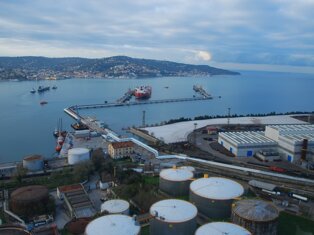
Located in the Bay of Muggia, the maritime terminal of the Transalpine Oil Pipeline is a strategic node for crude oil unloading and transfer, connecting the Port of Trieste with the industrial regions of Bavaria and Baden-Württemberg.
The site lies at the intersection of maritime infrastructure, sensitive coastal landscapes, and highly regulated industrial systems, where operational performance, safety standards, and environmental conditions must be continuously aligned.
Challenge
The project responds to a combination of interdependent factors:
- upgrading a degraded and highly constrained site
- reducing environmental and operational risk
- optimising land use within strict safety parameters
- accommodating constraints imposed by pipeline dimensions, anchorage systems, road reconfiguration, and edge realignment.
The challenge was to guide these transformations through a single, coherent framework, avoiding fragmented or purely sector-based solutions.
Landscape approach
A coordinated design framework was developed to align:
- landscape and land management
- environmental systems
- geotechnical and structural components
- pipeline infrastructure
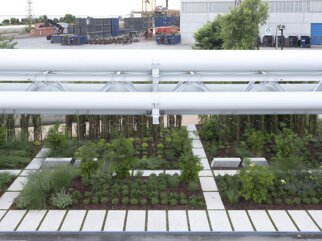
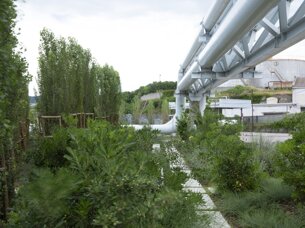
Landscape was treated as an integral component of the infrastructure, contributing to spatial organisation, environmental control, maintenance and long-term operation, rather than acting as a post-hoc mitigation layer.
Design decisions addressed operational needs and territorial relationships, including:
- structural alignment and spatial hierarchy
- maintenance and access routes
- planting strategies supporting ecological functions
- integration of infrastructure within surrounding coastal settlements
Through this approach, infrastructure systems are conceived as part of a continuous territorial structure, rather than isolated technical elements.
Value
The project demonstrates how an infrastructural landscape approach can connect technical systems and territorial context, allowing infrastructure to operate as part of the landscape rather than against it.
By treating landscape as an everyday territorial condition, the framework enabled:
- coordinated management of technical, environmental, and spatial systems
- clearer legibility of complex infrastructural processes
- alignment between safety requirements, environmental responsibility, and landscape values
- decision-making that remains place-specific, operationally viable, and adaptable over time
In this sense, landscape is not an added value, but the structural medium through which strategic infrastructure becomes legible, governable and compatible with its territorial setting.